📄 Digital book in PDF · read it on your phone or print it
Groundwater, siting, drilling, casing and screens, yield tests, pump sizing, installation, water quality and fault finding. Every topic has its own page: first the drawing, then what you need to remember. 65 illustrated pages.
🔒 Secure checkout · PDF by email · 30-day guarantee
Every page has one big drawing and a box with the depths, sums and steps you need to know:


Swipe to see more →
These are real pages from the book. The table of contents is the full one: 9 parts and 61 topics.
You're standing at a new borehole. The blow looked strong, the client bought a pump to match it, and by the end of the dry season it's sucking air.
You look it up. The manual gives you pages on aquifers, test durations and recovery curves, all in paragraphs. Nowhere does it just show you why the blow figure and the pumping figure aren't the same number.

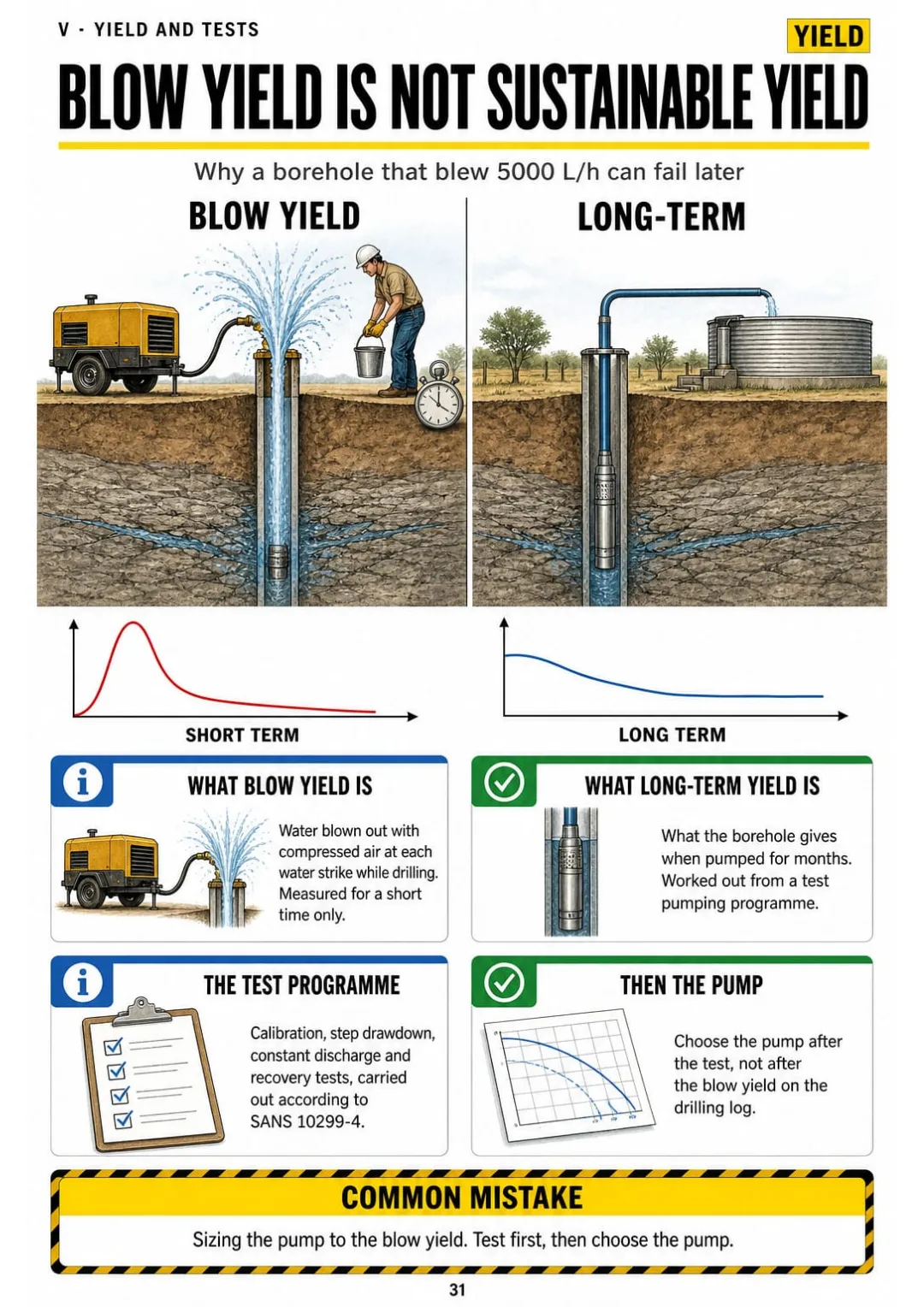
In the book it's one page. On one side, a short burst of compressed air lifting water out of the hole. On the other, the test pumping programme in SANS 10299-4, with the water level drawn falling and coming back. Blow yield on the left, sustainable yield on the right, and you see the gap.
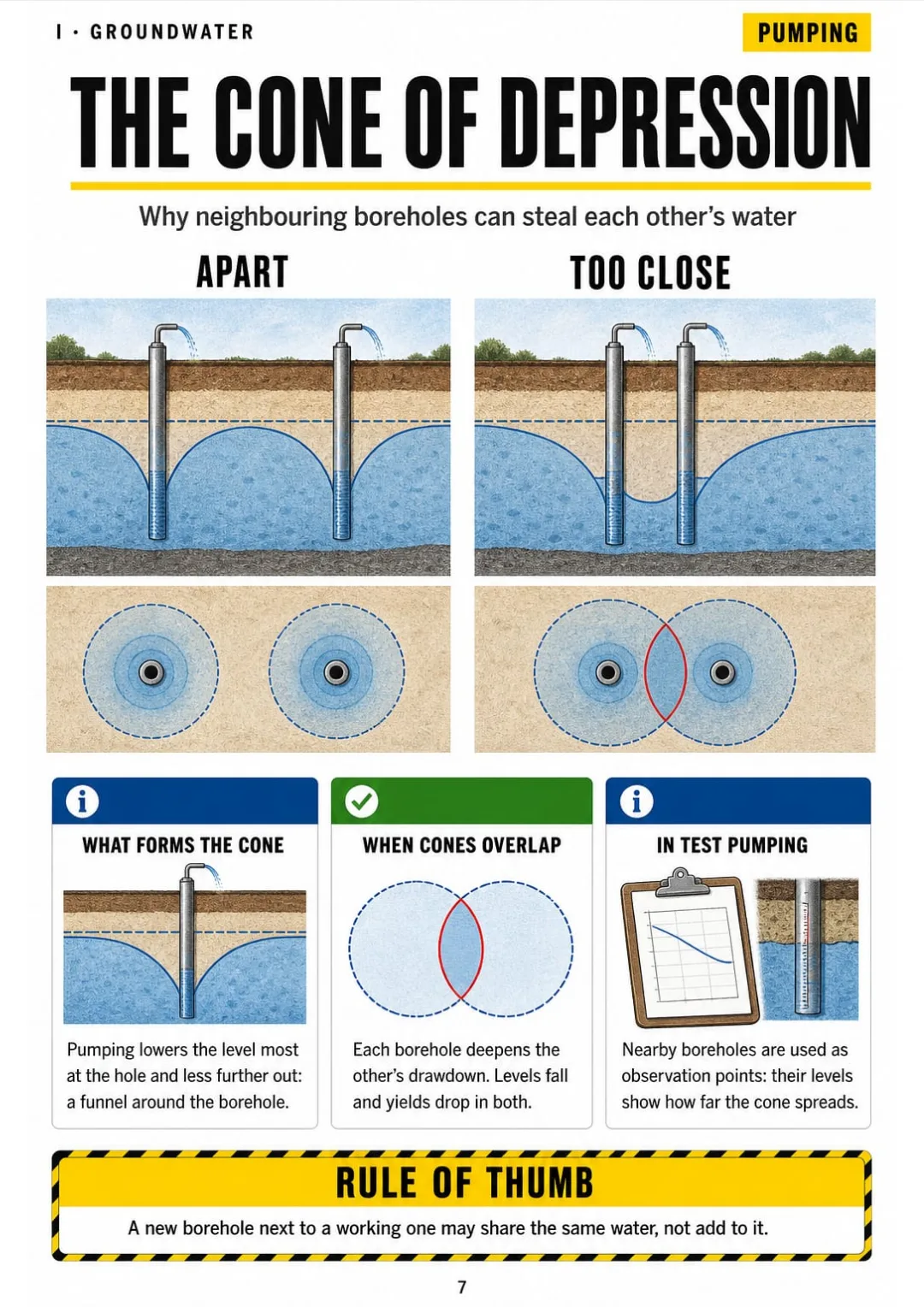
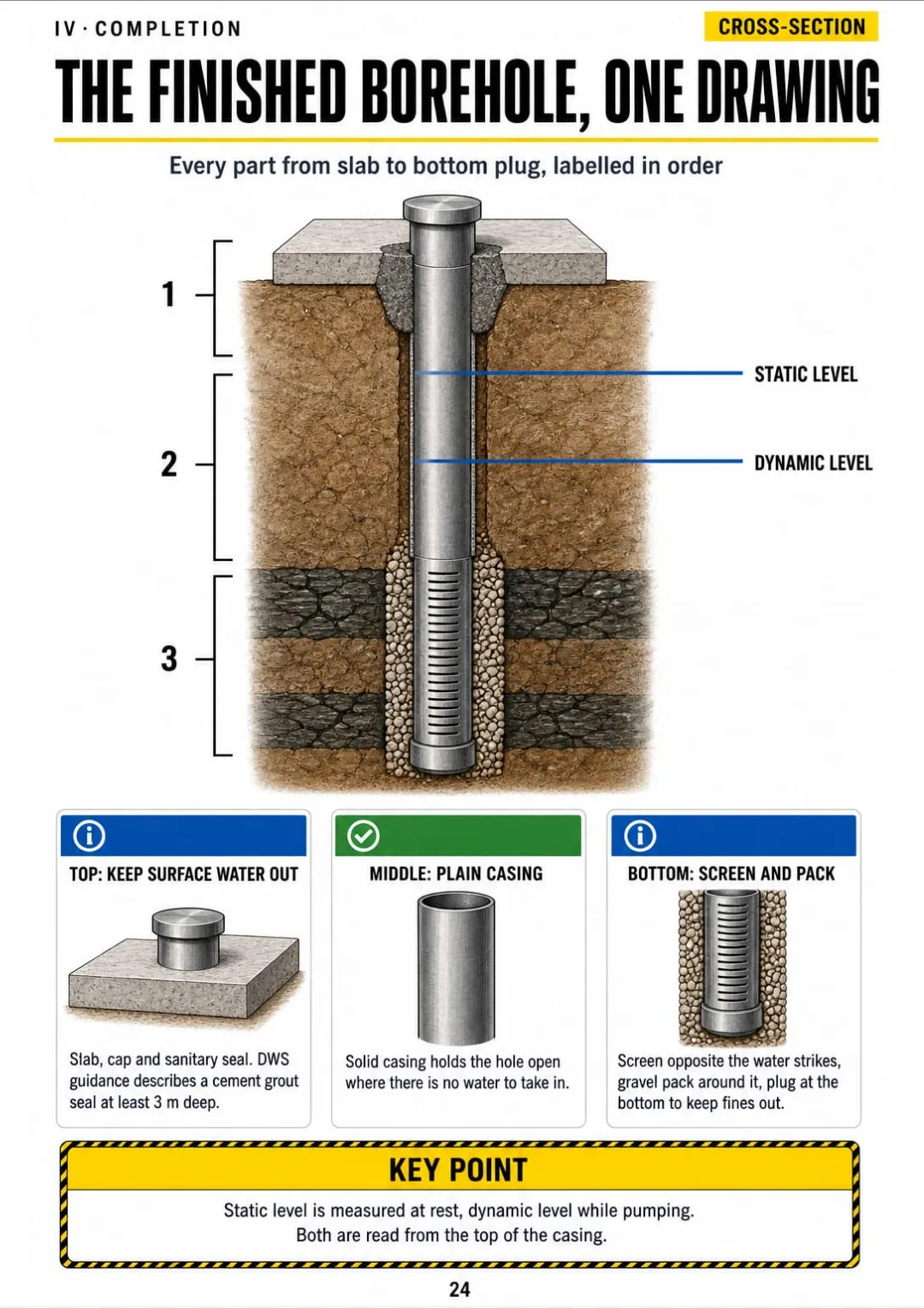
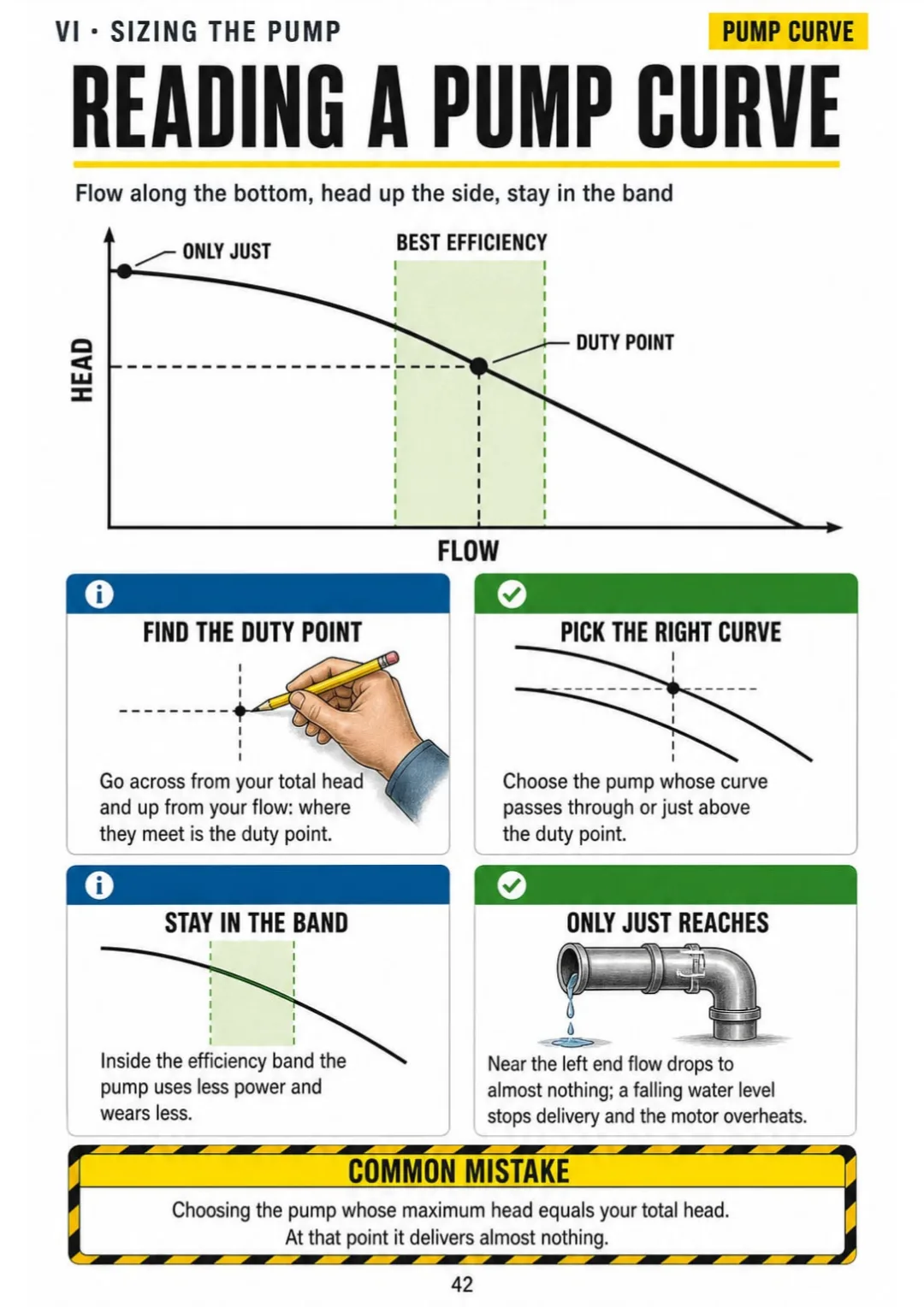
Static and dynamic level, the sanitary seal, total head, the pump curve and the fault-finding order work the same way: each one has its own page.
The next time a client asks why you won't size the pump off the blow, you explain it with the drawing in your head, without going back to the manual.

Groundwater, siting and the rules, drilling, casing and completion, yield tests, pump sizing, installation and electrics, water quality and maintenance, and fault finding: 65 pages, all illustrated
Think of it this way:
It's Monday morning on a farm in the Free State. The owner wants a new pump on an old borehole and asks two things: how deep to hang it, and how big it must be.
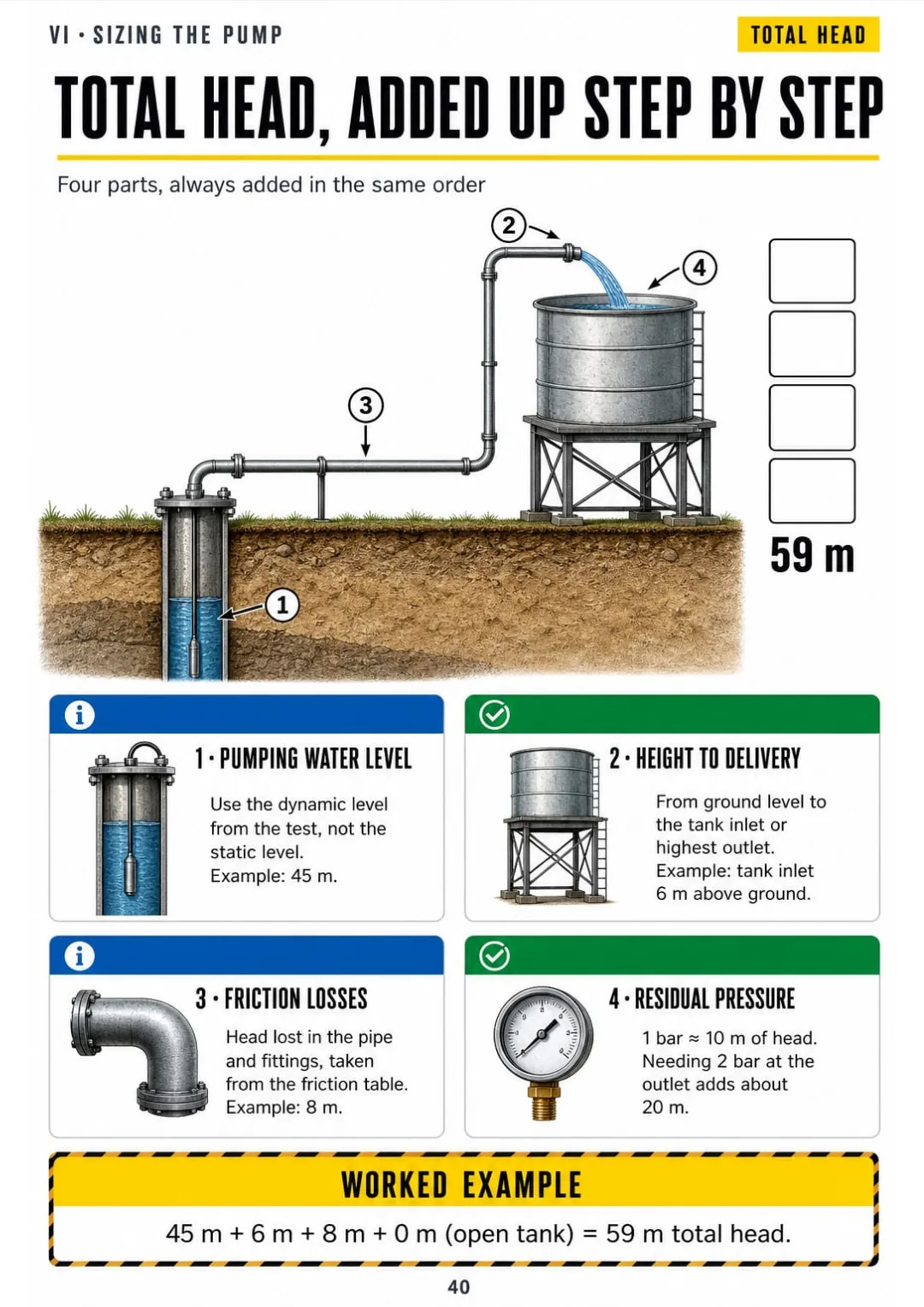
You open the page on total head. Dynamic level, the lift to the tank inlet and the friction loss, drawn as three blocks and added up: 45 m + 6 m + 8 m = 59 m. The next page shows you where that duty point must sit on the pump curve.

The same goes for the sanitary seal, the step drawdown test, non-return valves, the megger test and iron bacteria: each one on its own page.
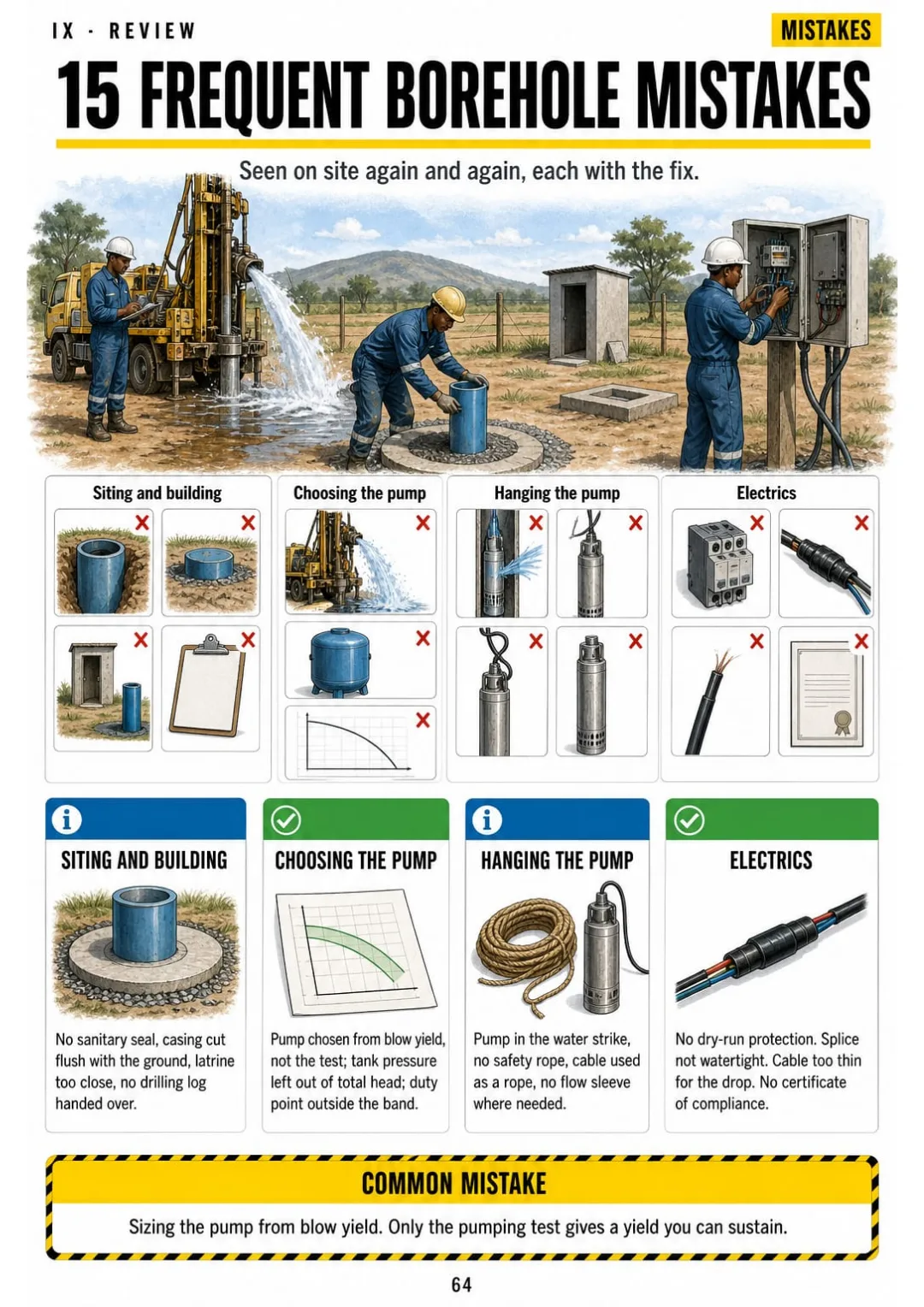
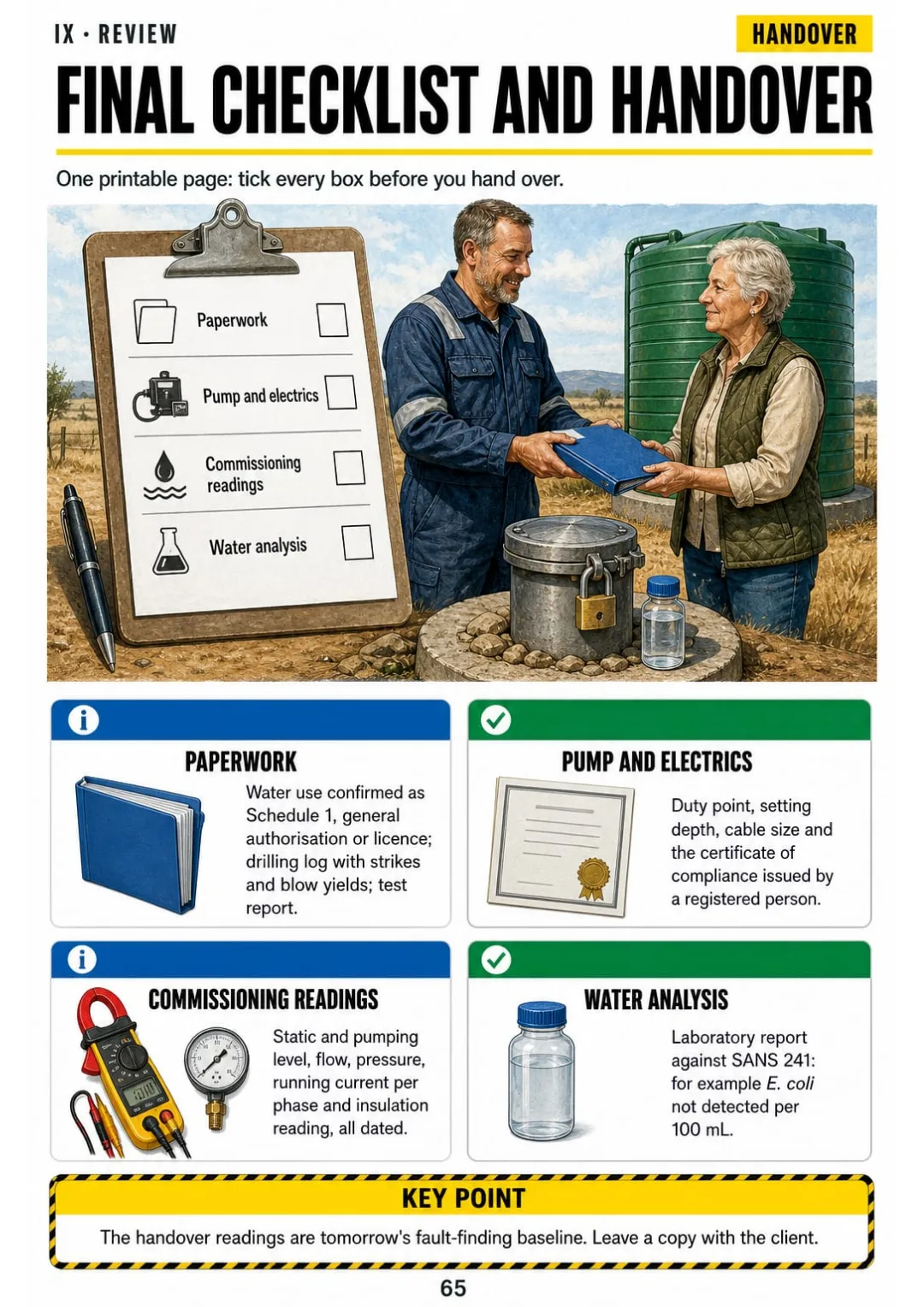
Boreholes and Pumps Illustrated is 65 illustrated pages in 9 parts, and at the end there are 15 frequent mistakes and a final checklist for the handover.
What you see drawn, you don't have to memorize.
Where borehole water comes from, static and dynamic level, drawdown, the cone of depression, recharge and drought, water strikes and artesian boreholes.
Choosing the spot by geology, distance from pollution sources, water use under the National Water Act, access and power, site safety and the borehole record.
Air percussion and mud rotary, hole versus casing diameter, the overburden, the drilling log metre by metre, blow yield and when to stop.
The finished borehole in cross-section, steel or uPVC casing, screens and slot size, gravel pack, sanitary seal and slab, development and disinfection.
Blow yield versus sustainable yield, dip meter and airline, step drawdown, constant discharge and recovery tests, reading the results and daily water needs.
Pump types, the duty point, total head step by step, friction loss, reading a pump curve, where to hang the pump, motor cooling and cable sizing.
Rising main, safety rope and cable strapping, non-return valves, the splice, the control panel, earthing and the electrician's certificate of compliance, and the first start.
What a drinking water test checks, taking a sample correctly, iron and manganese, the monthly logbook and rehabilitation when the yield drops.
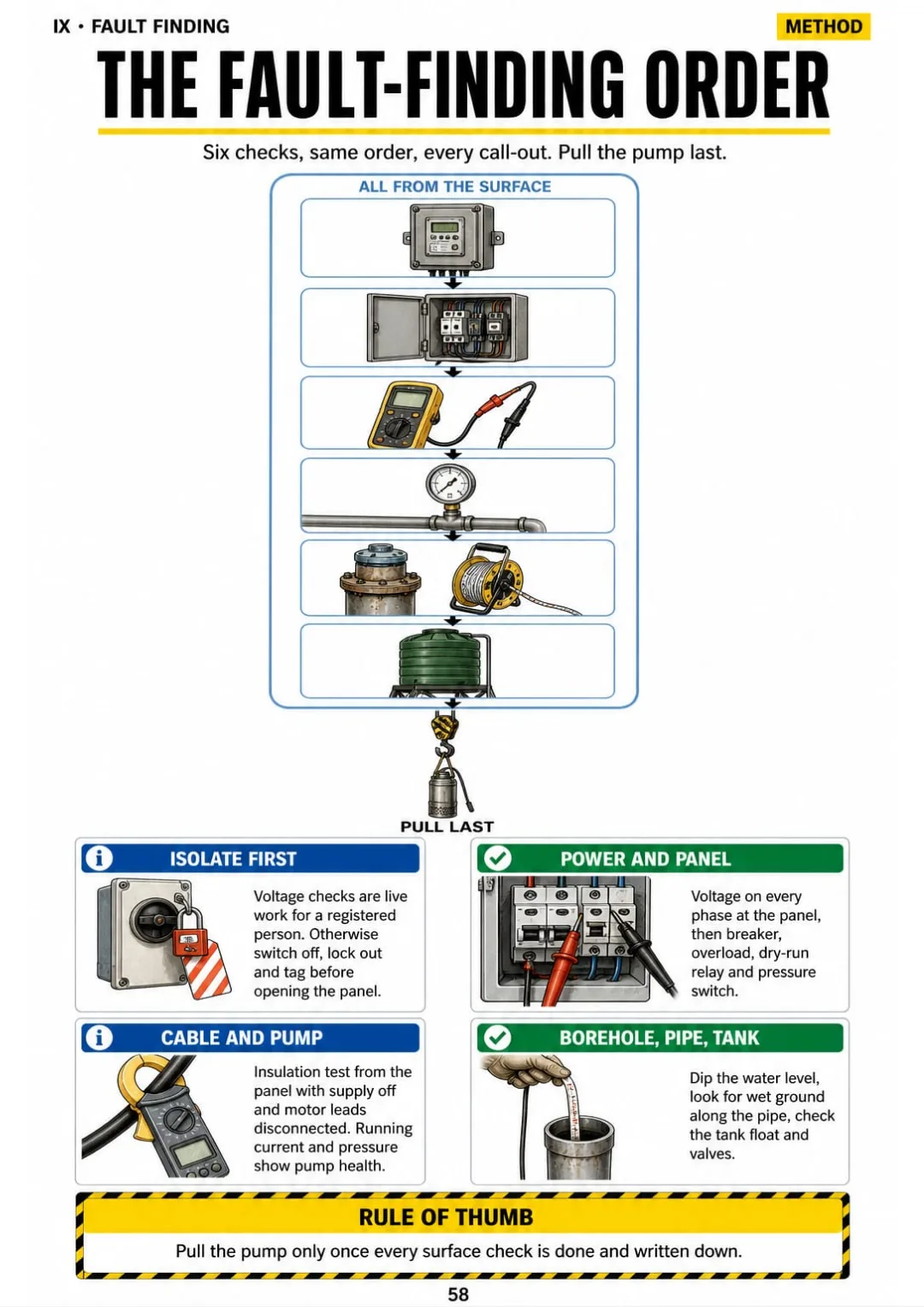
The fault-finding order, no water at the tank, low flow, tripping, the megger test, air in the line, 15 frequent mistakes and the handover checklist.
At the end of the book: 15 frequent borehole and pump mistakes drawn, and a final checklist for the handover.


Practise the sums you do on site: blow yield in litres per hour, drawdown, total head and friction loss, with step-by-step answers to check your working.

Quick cards to keep in the bakkie: the most frequent borehole and pump mistakes drawn before and after, and the fault-finding order for no water, low flow and tripping.
📄 This is a digital PDF book sent to your email: nothing is printed or shipped.
PDF by email: We email you Boreholes and Pumps Illustrated as a PDF, together with the two free books. It's a single payment: no installments, no extra charges.
You show a new helper the whole job in order, from siting to the sanitary seal, on the page, instead of explaining it in pieces between jobs.
Total head, friction loss, the pump curve and pump depth are worked out step by step in metres and litres, so you can check your own sums.
When a pump trips you follow the same six checks every time: power at the panel, what the protection tripped on, the float switch, the water level, the line and valves, then the megger test. Only then do you pull the pump.
📄 This is a digital PDF book sent to your email: nothing is printed or shipped.
Try Boreholes and Pumps Illustrated for 30 days, bonus books included.
We refund everything if the file won't open, if the book isn't what you see here, if you were charged twice or if the email doesn't arrive. Just email us.
You pay once. No subscriptions.
Yes. It's not a beginner's book. It lays the whole job out in order, from siting to handover, so you can check your sums, size a pump and explain it to a client or a new helper.
From the South African guidance in force: SANS 10299, the National Water Act 36 of 1998, SANS 241, SANS 10142-1, the Occupational Health and Safety Act 85 of 1993 and Department of Water and Sanitation guidelines. Every figure is in metres, litres, millimetres and kilowatts, never feet or gallons. The standards are referred to by name, not reproduced, so check figures against the current official version.
No. It's an independent illustrated book. It isn't affiliated with or endorsed by SABS or any government department.
No. It's a study and reference book. It doesn't replace on-site training, a geohydrologist's assessment, a registered electrician's work and certificate of compliance, or a water analysis by an accredited laboratory.
No. The worked examples and exercises are written for this book. They aren't taken from any exam, course or certificate.
The book and the 2 bonuses come as PDFs by email, to the address you enter when you pay.
No. It's a single payment, with no subscription.
It's a PDF, not a printed book. You can print the pages you use most and keep them in the bakkie or the pump house.
You have 30 days. We refund everything if the file won't open, if the book isn't what you see on this page, if you were charged twice or if the email doesn't arrive: just email us.
No more rereading the manual with nothing sticking.
The finished borehole, from slab to plug: one drawing and you've got it.
You get to site knowing where everything is.
Drawings make studying faster.
The book is right below.
One-time payment: US$ 27 · Guarantee: 30 days · PDF by email
YES, I WANT BOREHOLES AND PUMPS ILLUSTRATED FOR US$ 27📄 This is a digital PDF book sent to your email: nothing is printed or shipped.